
The short answer
Walk the house with everyone, find a second way out of each room, check that every window and door on those routes opens, pick a fixed meeting spot out front, and assign a helper to anyone who needs one. Write it on one page, then run a timed drill. Once the alarm sounds, NFPA puts your window at just a minute or two, USFA at under two minutes, and the Red Cross at two minutes or less, so the goal of the drill is everyone at the meeting spot within two minutes [1][3][5]. Print the checklist below to keep track.
Ember & Exit uses affiliate links, marked “(paid link)”. As an Amazon Associate I earn from qualifying purchases. Full disclosure.
Emergency
In a fire, get out and call 911. Get everyone out first, call from outside, and never go back in for belongings.
Who this plan is for, and what it has to do
This guide is for anyone who sleeps under a roof with other people, or alone, and has never sat down to decide how they’d get out at night. A home fire escape plan costs nothing, and you can draft one in an evening. It has one job: when the alarm goes off, nobody in the house should have to think. Every person already knows which way to go, who they’re responsible for, where to stand outside, and that they don’t go back in.
To do that job, your plan has to settle five things:
- A second exit from every room where someone sleeps, in case the usual route is blocked [1][3].
- A wake-up signal that reaches every sleeper, which in practice means working smoke alarms in and outside bedrooms and on every level [1][2].
- A named helper, and a backup, for anyone who can’t get out alone [1].
- One meeting spot outside, in front of the home, and one person who calls 911 from there [1][3].
- Practice, at least twice a year, including once after dark [1][4][7].
How we built this guide
We didn’t run drills in anyone’s home or test any product for this page. On October 20, 2026, we read the escape-planning and smoke alarm guidance published by the National Fire Protection Association (NFPA), the U.S. Fire Administration (USFA), Ready.gov, the American Red Cross and UL’s Fire Safety Research Institute (FSRI) [1]–[11]. Where those sources say the same thing, we say it once. Where they differ, we show you the difference rather than picking a winner silently. Read more about how we research.
We label claims the same way on every page:
- Agency guidance: advice published by NFPA, USFA, Ready.gov, the Red Cross or FSRI, cited to the page.
- Maker claim: a product figure or compliance statement that only the manufacturer publishes.
- Marketing language: wording with nothing checkable behind it.
Most of this page is agency guidance. The only product we name is an escape ladder, and its standard claim is labeled as a maker claim.
The five decisions, one at a time
1. A second exit for every room
Stand in each bedroom and ask: if the hallway were full of smoke, how would the person sleeping here get out? NFPA suggests drawing a floor plan with each room’s two exits, including windows, and marking where every smoke alarm sits [1]. USFA’s version is the same: map every door and window, find two ways out, and make sure nothing blocks them [3].
Then try each route. Ready.gov’s checks: no stuck windows, screens that pop out fast, and security bars that actually open [11]. NFPA adds that any bars on doors or windows need a quick-release device on the inside [1]. A window you can’t open from a sitting position, half asleep, isn’t an exit yet.
2. How everyone wakes up
A plan only works if the alarm reaches every sleeper. NFPA and USFA both call for smoke alarms inside each bedroom, in the hall or area just outside the bedrooms, and on each floor, and NFPA adds the basement [2][10]. NFPA recommends interconnected alarms, so that one alarm sounding sets off all of them [2], and USFA says the same [10].
During your first drill, watch who doesn’t wake up. NFPA says to find out whether children and others actually wake to the alarm, and if someone doesn’t, to assign a person to wake them, in the drill and in a real fire [1]. For anyone who is deaf or hard of hearing, NFPA points to strobe alarms and pillow or bed shakers that work with the smoke alarm, chosen from products listed by a qualified testing laboratory [2].
3. Who helps whom
Write names, not roles. NFPA says to assign someone to each infant, older adult or person with limited mobility, plus a backup in case that person isn’t home [1]. Ready.gov asks you to decide who will help each child under six [4]. If someone uses a walker or wheelchair, Ready.gov suggests checking that they can get through every doorway on their route [11].
4. The meeting spot and the call
Pick something that won’t move: a neighbor’s house, a light post, a mailbox or a stop sign, out front and well clear of the house [1]. USFA also puts the meeting place in front of the home [3]. Ready.gov’s sequence for a real fire is to reach the meeting spot first, then call 911 [4]. The Red Cross adds that everyone should know how to call 911 [6], and NFPA suggests making sure everyone knows the emergency number so they can call from a neighbor’s phone or a cell phone once they’re out [1].
While you’re outside, look at your house number from the street. NFPA and the Red Cross both say it should be easy for responders to read, and the Red Cross adds “even at night” [1][6].
5. The rules for the way out
These are short enough for a five-year-old to repeat:
- Get out, stay out. Never go back in for anyone or anything. If someone is missing, tell the dispatcher or the firefighters [1][5].
- Low under smoke. Rehearse dropping down and heading for the exit beneath the smoke [1][4].
- Feel before you open. Ready.gov says to use the back of your hand on a door and its knob. If either is hot, or smoke is coming around it, keep it shut and take your second way out [4][11].
- Shut doors behind you. NFPA says closing doors as you leave slows the fire [1].
- Don’t hide. Ready.gov wants children to learn that hiding from firefighters is the wrong move [11].
- Stop, drop and roll if clothes catch fire [6][8].
Walk the house first: a room-by-room check
Do this in daylight before your first drill. Look for the small things that turn an exit into a dead end: a painted-shut window, a dresser in front of a door, a screen nobody has ever removed.
| Room | Exit 1 (usual) | Exit 2 (backup) | Check before you count it |
|---|---|---|---|
| Each bedroom | Door to hallway and stairs | Window, or a second door | Window opens fully from inside; screen comes out; nothing under or in front of it [1][4][11] |
| Upstairs bedroom | Door to stairs | Window plus an escape ladder | Ladder stored in that room and fitted to that window before you need it (see our escape ladder guide) [1] |
| Basement bedroom | Stairs | Window or door to the outside | A smoke alarm on this level; the window opens fully and nothing blocks it [1][2][4] |
| Living areas | Front door | Back or side door | Doors open easily; nothing stored in the path [1][3] |
| Apartment | Your unit’s door | Building exit stairs | You know where every exit stair is; you don’t use the elevator [3] |
Running your first drill
- Tell everyone first. NFPA says to let children learn and practice the plan before you ever run a drill while they’re asleep, and that announcing a drill ahead of time can work as well as a surprise [1].
- Start it with the real sound. USFA says to push the smoke alarm’s test button to begin [3]. The Red Cross also suggests yelling “Fire” [6].
- Send people to where they sleep. Ready.gov’s drill starts with kids in their bedrooms, an adult assigned to each young child, and one adult running the drill and the timer [4].
- Use the second exit at least once. Fires can start anywhere, so Ready.gov suggests practicing different ways out and at different times of day or night [4]. Ready.gov also suggests one run with the lights off, or with eyes shut, feeling your way out [11].
- Time it. Stop the clock when the last person reaches the meeting spot. Under two minutes is the target the Red Cross and Ready.gov use [4][7]. If you’re slower, find the slow step and fix that, not the whole plan.
- Repeat twice a year. NFPA asks you to make drills as realistic as you can [1]. Once everyone knows the plan, make one of them a nighttime drill [1][4].
If you have an escape ladder, practice setting it up from a ground-floor window only. NFPA says children should practice with an adult, at a first-story window [1].
Where the agencies agree, and where they differ
The core plan is the same everywhere. A few details differ, and it helps to know which one you’re following.
| Topic | NFPA | USFA | Ready.gov | Red Cross |
|---|---|---|---|---|
| Time you may have once the alarm sounds | 1 to 2 minutes, possibly less [1] | Less than 2 minutes [3] | Drill target: out in under 2 minutes [4] | 2 minutes or less [5] |
| How often to drill | Twice a year [1] | Practice with everyone; no interval given on the plan page [3] | At least twice a year [4] | At least twice a year [7] |
| How often to test smoke alarms | Monthly [2] | Monthly [10] | Twice a year on the plan page [4] | Monthly [5][7] |
| Replace smoke alarms | 10 years after the manufacture date [2] | Every 10 years, or per the maker for sealed 10-year units [10] | Every 10 years or per the maker [11] | At 10 years old [7] |
| Meeting spot | In front, a safe distance away [1] | Outside, in front of the home [3] | A safe distance from the home [4] | Decide where to meet outside [8] |
Where they differ, we’d follow the stricter number: test alarms monthly, drill twice a year, and aim for two minutes.
Homes that need a different plan
Upper floors
NFPA says that in a two-story home, everyone, including children, has to be able to get out of the second-floor rooms, and that an escape ladder can provide that extra route [1]. Ready.gov lists an escape ladder as a second way out of upper-level rooms [4]. If you need one, our fire escape ladder guide covers sill fit, height limits and which ladders name a standard.
Apartments and high-rises
USFA’s high-rise steps differ from a house plan. Find every exit stairwell in the building. When you leave the apartment, shut its door, and set off the building’s fire alarm as you go. Take the stairs; skip the elevator unless firefighters direct you to use it. Then wait at your meeting spot, and let the fire department know about anyone still inside [3]. NFPA notes that people in high-rise and apartment buildings may sometimes be safer “defending in place” [1], so learn your building’s own evacuation plan.
Someone who is deaf or hard of hearing
Plan the wake-up first. NFPA points to strobe alarms and bed or pillow shakers that work with smoke alarms, and says to choose listed products [2]. NFPA also suggests sleeping with your phone and hearing aids or implants close to the bed [2]. Ready.gov mentions alarms that flash or vibrate for people with hearing loss, and audible alarms for people with low vision [11].
Young children
Keep it calm and concrete. Ready.gov suggests showing children what the alarm sounds like, teaching them to go to the meeting spot, never to go back inside, and to get low [4]. If a child might use a ladder, Ready.gov says to point out where it’s kept and practice with it [4]. NFPA’s point about drills applies here most: the aim is practice, not fear [1].
Older adults and anyone who moves slowly
Give them a named helper and a backup [1]. Check doorway widths for walkers and wheelchairs [11]. NFPA asks households to make specific arrangements for anyone with a disability [1].
Guests, sleepovers and pets
Tell overnight guests your plan. When your children sleep over at a friend’s house, NFPA suggests asking about that household’s plan [1]. For pets, the rule stays the same: you don’t go back in. Ready.gov says to tell firefighters right away if a pet is trapped inside [11].
If you can’t get out
Sometimes the door and the window are both blocked. Ready.gov and NFPA describe the same steps [1][11]:
- Close every door between you and the fire.
- Stuff towels or tape into the gaps around the door and over vents.
- Call 911 or the fire department and say exactly where you are.
- Signal at a window with a flashlight or a light-colored cloth.
Close bedroom doors at night
This habit costs nothing. FSRI’s “Close Before You Doze” campaign says a closed door can mark the difference between 1,000 and 100 degrees on either side of it in a fire, and between CO levels of 10,000 and 1,000 ppm [9]. Ready.gov also says to sleep with bedroom doors closed [11]. With doors shut, it helps even more that interconnected alarms sound in every room when any one of them goes off [2].
If your plan finds a gap
Many plans need no new gear. When yours does, here’s what usually closes the gap, and what backs each item.
| Gap | What closes it | Certification status | Where to read more |
|---|---|---|---|
| No working alarm in or near a bedroom | Smoke alarm, plus a CO alarm in a central spot outside each sleeping area [6] | NFPA says to choose an alarm listed by a nationally recognized testing laboratory; U.S. smoke alarm listings are made to UL 217 [2][12] | Smoke and CO alarm guides |
| Someone sleeps through alarms | Strobe, or a bed or pillow shaker that pairs with the alarm | Choose one listed by a qualified testing laboratory, per NFPA [2] | Ask your fire department; see our alarm guides |
| An upstairs bedroom whose only second exit is a window | Escape ladder kept in that room | First Alert’s manual states ASTM F2175 compliance (maker claim) [13]; we found no third-party listing for a portable ladder | Fire escape ladder guide |
| A window you can’t open | Repair, not a product | — | Your landlord or a window contractor |
Best for an upstairs bedroom with no second exit: First Alert EL52-2. It’s the top pick in our ladder guide for second-floor sills 6 to 10 in. deep and no more than 16 ft off the ground. First Alert’s manual cites ASTM F2175 (a maker claim, not independent verification) [13]. Follow First Alert’s setup and use instructions, check your local codes, and treat a ladder as one part of your plan: it doesn’t replace working smoke and CO alarms or practiced drills.
Who should skip this: anyone whose room has a safe second door, whose window sill sits outside the 6 to 10 in. First Alert’s manual allows [13], or who sleeps on a third floor. The ladder guide covers those cases.
What you don’t need to buy
- Smoke alarms, if your fire department or the Red Cross will install them. The Red Cross installs free smoke alarms through home fire safety visits, depending on where you live [7]. USFA notes that some fire departments hand out alarms free or at a discount, and some install battery alarms for free, so call your department’s non-emergency number first [10].
- A ladder for a ground-floor room. If the window is low enough to step out of, the plan only needs that window to open.
- A “fire safety kit” in place of a drill. None of the sources we read puts gear ahead of planning. NFPA ties your chance of getting out to two things: early warning from smoke alarms and planning ahead [1].
The printable checklist
Print this, fill it in at the kitchen table with everyone, and put it where people will see it.
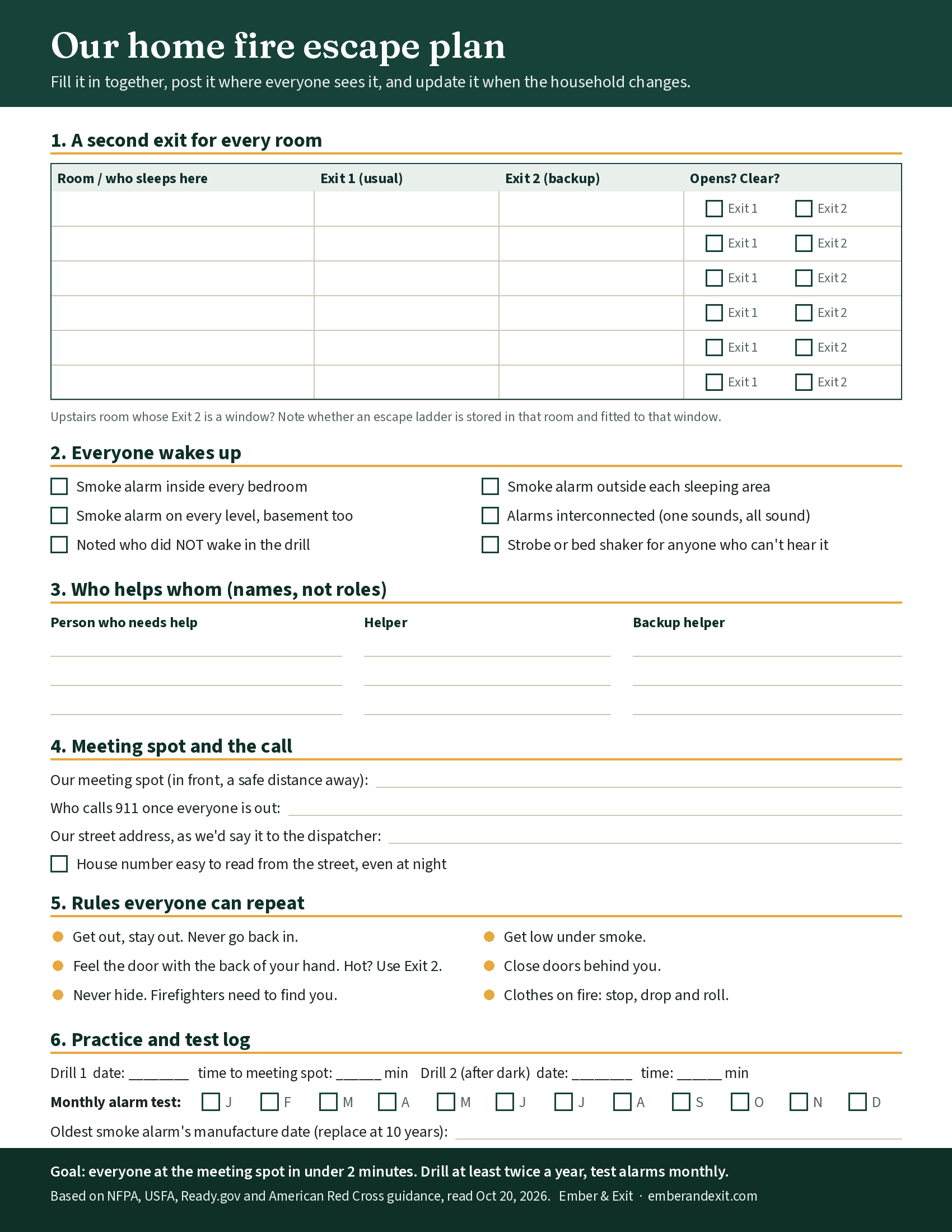
The checklist covers the five decisions above, a room-by-room exit grid, the wake-up check, and spaces to log monthly alarm tests and two timed drills a year. It contains no shopping links.
Download the printable checklist (PDF)
FAQ
A floor plan with two exits from every room, the location of each smoke alarm, a meeting spot in front of the home, the name of whoever helps each person who can’t get out alone (plus a backup), and who calls 911 [1][3][4].
Twice a year or more, according to NFPA, Ready.gov and the Red Cross [1][4][7]. Ready.gov suggests varying the time of day and the exits you use [4].
NFPA puts it at a minute or two after the alarm sounds. USFA says under two minutes, and the Red Cross says two minutes or less [1][3][5]. Ready.gov’s drill target is under two minutes [4].
At something fixed out front and well away from the house, such as a neighbor’s house, a light post or a mailbox [1][3]. Mark it on the plan.
Yes, once they know the plan. NFPA says to let children master the plan before a nighttime drill, and that telling them about the drill in advance can work as well as a surprise [1]. Check whether they wake to the alarm. If not, assign someone to wake them [1].
Know every exit stair, close your door as you leave, pull the building alarm, take the stairs rather than the elevator, and meet outside [3]. NFPA notes that in some high-rise and apartment buildings, defending in place may be safer [1], so ask your building manager what your building’s plan is.
Where this guide stops
What we did and didn’t do. We didn’t inspect any home, run any drill, or test any product. This guide summarizes NFPA, USFA, Ready.gov, Red Cross and FSRI guidance as published on October 20, 2026, and points out where they differ. It isn’t a code inspection: building and fire codes vary by place, so ask your local fire department or building department about window sizes, alarm requirements and your building’s own evacuation plan. The one product named here carries a maker’s standard claim, not a third-party listing. Read our full method in how we research.
Bottom line
Your home fire escape plan is a page of decisions you make now, so nobody has to make them at 3 a.m. Find a second exit for every room, make sure the alarms wake everyone, name the helpers, pick the meeting spot, and run a timed drill twice a year. Most homes need nothing new to do this. If yours does, fix the gap the plan turns up, and nothing more.
First Alert is a trademark of its owner. Ember & Exit is not affiliated with any of the organizations or companies named here.
Next step
- Upstairs bedrooms? Read our fire escape ladder guide, then browse escape ladders and planning.
- Alarms first. See our smoke and CO alarm guides. Our guide to combination smoke and CO alarms is coming soon.
- Kitchen and extinguishers. Browse kitchen fire safety and fire extinguishers. Our guides to home fire extinguishers and kitchen fire blankets are coming soon.
- Ready to buy a ladder? First Alert EL52-2 (paid link)
Last reviewed: October 20, 2026.
Sources
- National Fire Protection Association — Home Fire Escape Planning (one or two minutes to escape; floor plan with two ways out and alarm locations; clear routes; meeting place in front; visible house number; memorize the emergency number; helper and backup; security bar releases; guests and sleepovers; defend in place in high-rises; stay out; drill twice a year; disability arrangements; children master the plan before night drills; check who wakes; ladders for second-floor rooms and first-floor practice; get low; close doors; sealing in). https://www.nfpa.org/education-and-research/home-fire-safety/escape-planning
- National Fire Protection Association — Smoke Alarm Information (alarms in every sleeping room, outside each sleeping area, every level and basement; interconnected alarms; test monthly; replace 10 years after manufacture; alarms listed by a nationally recognized testing laboratory; strobes and bed shakers listed by a qualified testing laboratory; keep phone and hearing aids close). https://www.nfpa.org/education-and-research/home-fire-safety/smoke-alarms
- U.S. Fire Administration (FEMA) — Home Fire Escape Plans (less than 2 minutes once the alarm sounds; map with doors and windows; 2 ways out; keep exits clear; meeting place in front; start the drill with the test button; high-rise steps). https://www.usfa.fema.gov/prevention/home-fires/prepare-for-fire/home-fire-escape-plans/
- Ready.gov — Practice Your Home Fire Escape Plan (written plan; out in under 2 minutes; alarms on every level and in each bedroom, tested twice a year; two ways out; escape ladder for upper rooms; get low; safe meeting place; drills at least twice a year; children under six; back-of-hand door check; drill steps; different times and exits; meet, then call 9-1-1). Last updated March 25, 2026. https://www.ready.gov/home-fire-escape-plan
- American Red Cross — Home Fire Prevention & Safety Tips (as little as two minutes to escape; alarms on every level, inside bedrooms and outside sleeping areas; test monthly; practice twice a year; get out, stay out, call for help). https://www.redcross.org/get-help/how-to-prepare-for-emergencies/types-of-emergencies/fire.html
- American Red Cross — 7 Ways to Prepare for a Home Fire (two ways out and a meeting spot; practice twice a year; press the test button or yell “Fire”; everyone knows how to call 9-1-1; stop, drop and roll; CO alarm outside each sleeping area; house number readable at night). https://www.redcross.org/get-help/how-to-prepare-for-emergencies/types-of-emergencies/fire/home-fire-preparedness.html
- American Red Cross — Sound the Alarm (2-minute drill at least twice a year; test alarms monthly; replace at 10 years; free smoke alarm installation through home fire safety visits, depending on location). https://www.redcross.org/sound-the-alarm.html
- American Red Cross — Home Fire Escape Plan worksheet, PDF (two ways out of each room; meeting place; time your drills; low crawling; stop, drop and roll). https://www.redcross.org/content/dam/redcross/atg/PDF_s/Preparedness___Disaster_Recovery/Disaster_Preparedness/Home_Fire/Home_Fire_Escape_Plan.pdf
- UL Research Institutes, Fire Safety Research Institute — Close Before You Doze (closed door: about 1,000 vs 100 degrees; CO 10,000 vs 1,000 ppm). https://closeyourdoor.org/
- U.S. Fire Administration (FEMA) — Smoke Alarms (both ionization and photoelectric, or dual-sensor; interconnected alarms; inside and outside each bedroom and on every level; test monthly; replace every 10 years, or per the maker for 10-year sealed units; some fire departments offer free or reduced-price alarms and installation). https://www.usfa.fema.gov/prevention/home-fires/prepare-for-fire/smoke-alarms/
- Ready.gov — Home Fires (check windows, screens and security bars; practice in the dark; teach children not to hide; walker and wheelchair doorways; sleep with doors closed; feel the door and knob; tell firefighters about trapped pets; sealing in and signaling; replace alarms every 10 years or per the maker; vibrating and flashing alarms). https://www.ready.gov/home-fires
- Intertek — Standards Update Notice for UL 217, Smoke Alarms (8th and 9th edition requirements; listings had to meet them by June 30, 2024). https://cdn.intertek.com/www-intertek-com/dms-legacy/UL-217-SUN-Rev-10-30-2015-11-23-2016-1-2-2020-and-2-9-2022-ED-6-30-2024-Amendment-1.pdf
- First Alert / BRK Brands — Model EL52 Nylon/Steel Fire Escape Ladder user’s manual (complies with ASTM F 2175-02; second-floor windows no higher than 16 ft from the ground; windowsill 6–10 in. deep). https://www.firstalertstore.com/store/images/pdf/EL52-2-First_Alert_Two_Story_Escape_Ladder.pdf